
Cracks of Doom
(1) Erosion, wear and tear, breakdown and decay — there is a universal pattern in this world. Even the seemingly indestructible pyramids of Egypt, once smooth and geometrically perfect, have been broken down by wind and sand, the blows of looters and the stresses of the unceasing cycle of hot days and cold nights. Behind disintegration in all its forms lurks a single malevolent agent — the crack.
(2) Since cracks lie behind the way things fall apart, they have received tremendous attention over the years. It was fairly easy to understand a single solitary crack moving on a straight and narrow path. But what of cracks that eschew straight lines or simple curves, following instead bewilderingly crooked paths? And what of the rough surfaces created when a crack rips through a brick? Snap a wafer of silicon in two and the newly formed surface, when magnified 300 times, seems rather smooth. But magnified 3,000 times, it looks a little bumpy, and at 15,000 times, quite hilly. And the remarkable thing about these complex broken landscapes is that they always seem to turn out the same. (3) Chernobyl is in Ukraine, close to the Belarus border. At the time of the accident, prevailing winds meant that 80 per cent of the fallout from the burning reactor fell in Belarus. The accident left vegetation and soil heavily contaminated with strontium-90, caesium-137, plutonium and americium. The population of the most heavily polluted areas was evacuated, but 8 million people still live in a contaminated zone where farmers grow some grain crops. Since the radioactive material concentrates in roots and stalks, they are ploughed back into the soil after harvesting. So the soil is almost as heavily contaminated today as it was after the accident. A study conducted in 1999 at the Centre for Ecology and Hydrology in Lancaster, UK, found that tens of thousands of people in the contaminated region are consuming dangerous levels of radioactivity in their food. The Belarus government hopes that by growing biofuels and using the whole plant, it will be able to cleanse the soil and make it fit for growing healthy foods in 20 to 40 years.
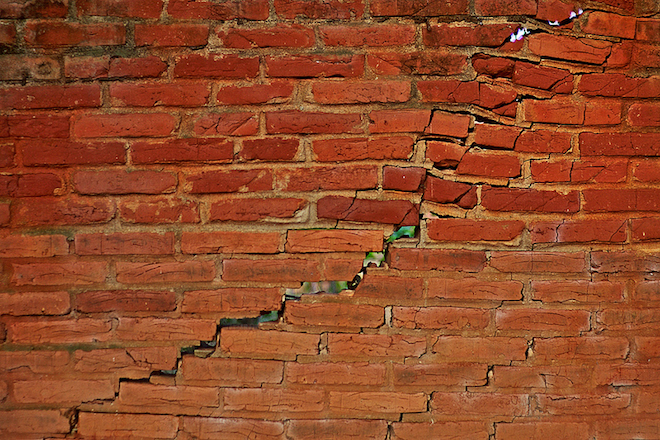
(3) Numerous experiments have shown that all manner of materials break in what seems to be a universal way. The resemblance is not just qualitative either. For any of the surfaces like silicon, the roughness becomes worse as it is looked at more closely, and in a precisely predictable way.
(4) This is puzzling. So is the roughness of newly broken surfaces. Smooth surfaces would seem especially likely when breaking perfect crystals. But it doesn’t usually work this way because of the curious behaviour of cracks. If you take Plexiglas — or any other brittle material — and pull its sides apart hard enough, a crack will suddenly form. In the first stage it forms and jumps in less than one millionth of a second from rest to about 200 meters per second. In the second stage it keeps accelerating, but at a much slower rate. In both of these stages of development, the crack leaves a smooth surface in its wake. But eventually, it begins to move so fast, that it becomes unstable. Above a certain speed the crack bucks and plunges, and veers haphazardly to the left and right. As it does so, it leaves a rough surface behind.
(5) Since fracture creates roughness all the way down to the atomic scale, the forces that make cracks grow must also be investigated at that scale. Therefore, Plexiglas, being a tangle of polymers, each a string of about a million molecules, makes things complicated. To understand fracture instabilities, it makes more sense to look at brittle crystals, where simple atoms are spaced regularly, at precise locations that are easy to describe.
(6) Theoretical models of hypothetical brittle materials give a good qualitative picture of what happens, but only up to the point where the crack begins to shudder. Once the tip becomes unstable, describing it precisely becomes difficult. Interesting clues, however, come from various experiments.
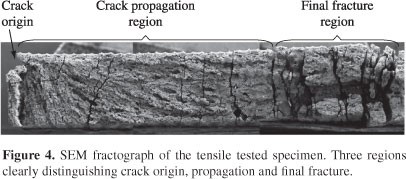
(7) One such observation comes from researchers at the Hebrew University. When a crack in brittle plastic speeds past the point of instability, it begins to sprout side branches in increasingly large numbers. And the side branches themselves throw off further, secondary side branches. Sprouting off from a crack, a side branch seems to form an angle of about 30 degrees with the main crack. But the closer you get to it, the steeper it looks. The steepness of the side branches increases in just the same way as does the roughness of fractured surfaces. Because of this connection, it may be possible to formulate a theory for the origin of rough surfaces based on the way that big cracks emit little ones off to the side.
(8) There is no better way to make confident predictions about the properties of new and unknown materials than to test various methods on familiar materials and see that the results are consistent with known properties. It is not enough to do these test on smooth and simple cases. Materials have to be tested against the roughest handling they will ever endure. Knowing how cracks become unstable will not restore the surfaces of the pyramids, but it may help us design materials that can outlast them.