
Can Giant Electromagnets Replace Ropes for Mooring Ships?
(1) Mooring a ship can be a time-consuming, labour intensive affair in which dock workers grab ropes hurled from the deck of the incoming ship and secure them to the dockside. Alternatives proposed in the past range from robotic arms that pull the ship to the shore, to outlandish underwater elevators that raise the vessel up out of the water and hold it secure at the dockside, free from interference by the tides. Dock workers may soon be able to forget about hauling on heavy ropes and chains. The gentle press of a button could be all it takes to keep a giant ship secured to the dockside. The port of Rotterdam in the Netherlands is testing an experimental system which uses a series of strong electromagnets built into the quay to moor giant container ships. If it works, they say the system could save them around 5 million Euro a year in labour costs, and speed the average turnaround times of a ship by 40 minutes.
(2) Docking magnets have always been ruled out in the past because of the risk of damaging sensitive cargo or on-board equipment, such as TV sets and computer monitors. Cathode-ray tube screens in TVs and monitors were especially vulnerable to magnetic interference. When their metal chassis became magnetised, the field sent the electron beam off centre, distorting colours. And such magnets might even make it impossible to remove steel freight containers from the hold.
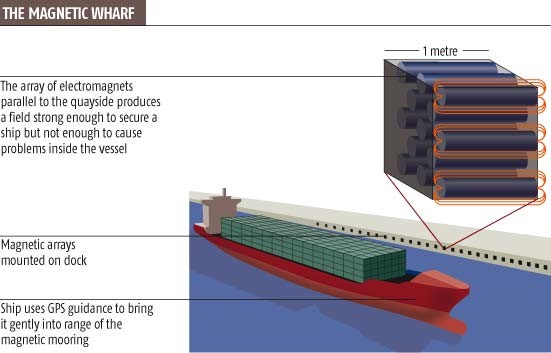
(3) Now researchers at the Delft University of Technology in the Netherlands claim to have developed an electromagnet that generates a magnetic field that does not penetrate too far into the ship. Each of their mooring magnets generates a 1-tesla* magnetic field. The magnets are formed from 13 long, thin, rod-shaped electromagnets placed side by side in a pattern that concentrates the magnetic field around the sides of the rods. The proximity of the rods ensures that the field from each is attracted to its neighbours, rather than extending very far forward, the inventors say. They are confident that their magnets will not affect anything inside a ship.
(4) The researchers calculate that 52 of these magnets mounted along a quayside will be capable of holding a 400-metre container ship in place. The magnets are strong enough to secure a ship in winds of up to storm force 12, and will be unaffected by the wash from passing ships. To allow the ship to rise and fall with the tide, magnets are periodically switched off and then on again. This will happen too fast for the ship to drift out of range. A key part of the Rotterdam trial is to see if this idea works.
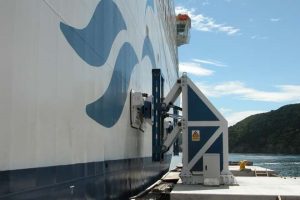
Montgomery Mooring System
(5) A rival system developed by Peter Montgomery of the Mooring Systems Company in New Zealand uses shore-mounted vacuum pods that cling to the side of a vessel. This system is almost entirely mechanical, using electric power only to attach the pods to the vessel. Montgomery points out that the Dutch magnetic system uses a lot of electricity and may be prone to power failures. But the Dutch designers assert that standby generators could guard against any power failures. In addition, they say the magnets are much smaller than the vacuum pods, which would be an advantage in a busy container port.
(6) Despite their optimism about the outcome of the tests in Rotterdam, the engineers are first and foremost concerned with safety. To back up the magnets, they will have mooring ropes to hand.
==
* Tesla is a unit of magnetic induction equal to one weber per square metre.